As part of the implementation of the Addresses of the Head of State for 2024 and 2025, the Government is implementing a comprehensive set of measures in the areas of public finance, infrastructure, investment, digitalization and social policy. The key objectives are set out in the nationwide action plans.
The nationwide action plans for 2024–2025 provide for 180 measures. Some have already been fully implemented, while the remaining tasks are in the active implementation phase and are being carried out within the strictly established timeframes.
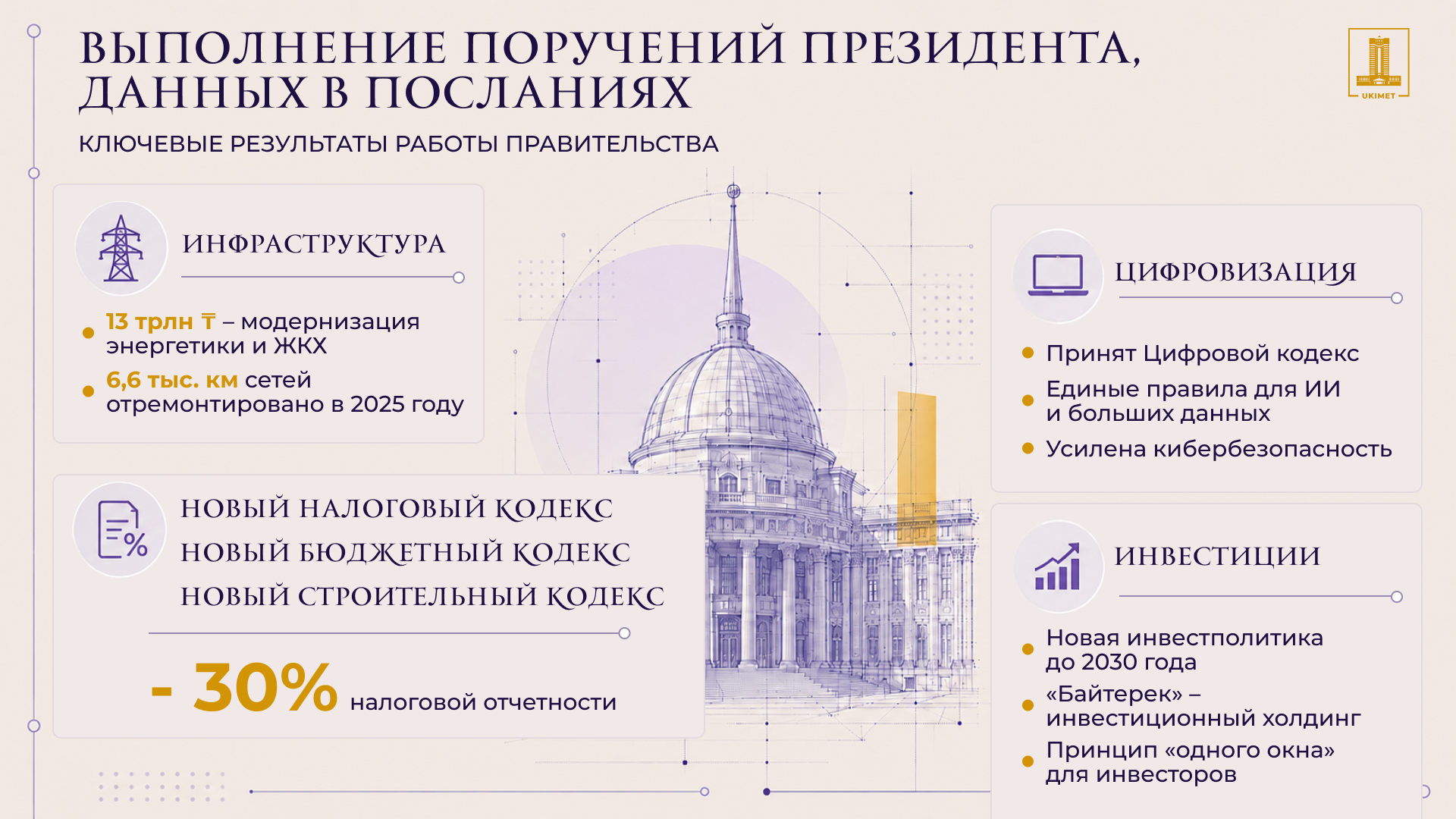
The practical impact of this work is already becoming evident across various sectors. In 2025, 6.6 thousand km of utility networks were repaired, and eight utility enterprises were removed from the ‘red zone’ of deterioration. At the same time, a new regulatory framework was established for the digital economy, artificial intelligence and investment policy.
Less Administrative Burden, Greater Efficiency
To address imbalances between monetary and fiscal policy, amendments were made to the Action Plan for Ensuring the Sustainability of Public Finances and Improving the Balance of Macroeconomic Policy for 2025–2027. The document was aligned with the Joint Action Programme for Macroeconomic Stabilization and Improvement of Public Welfare for 2026–2028.
A significant part of the assigned tasks was further developed within the framework of the new Tax and Budget Codes, which established a unified direction for fiscal modernization.
The new Tax Code has been in effect since 1 January 2026. It provides for a 30% reduction in tax reporting and a 20% reduction in the number of taxes. The system of tax benefits has been revised and differentiated rates have been introduced. For businesses, this means simplified administration, while the tax system is becoming more focused on stimulating investment and increasing the tax burden on luxury goods.
Tax administration is also transitioning to a digital model. The Smart Data Finance system automatically calculates tax liabilities based on data from government information systems and creates a digital taxpayer profile. The system has been put into full-scale operation, and its information database has been integrated with government bodies and organizations.
The new Budget Code, in turn, places emphasis on the quality of planning and the efficiency of public expenditure. An analysis of the impact of sectors on budget revenues has been introduced, making it possible to prioritize public investment projects and direct funding toward initiatives with the greatest economic impact.
In addition, separate monitoring of parafiscal payments and new budget liquidity management mechanisms have been introduced, helping to reduce the risk of cash shortfalls in the regions.
New Rules for Banks and the Quasi-Public Sector
A separate reform package concerns the development of the financial market and improved efficiency in the management of state assets. To regulate banking activities in light of the objectives of stimulating economic activity and developing financial technologies, the Law ‘On Banks and Banking Activities in the Republic of Kazakhstan’ was signed, together with related amendments to legislation concerning the financial market, communications and bankruptcy.
At the same time, the new Budget Code strengthened oversight of the finances of the quasi-public sector. Limits on external borrowing and rules governing dividend payments have been established for holdings, while their development plans are considered by Parliament concurrently with the national budget.
Samruk-Kazyna and Baiterek holdings have been tasked with ensuring investment in the country in accordance with the National Development Plan and the Investment Policy Concept. Baiterek has been transformed from a development institution into a fully fledged investment holding company. Its mandate is being expanded to include the financing and support of major infrastructure, industrial and export projects.
KZT 13 Trillion for the Modernization of Energy and Utility Infrastructure
One of the most significant practical outcomes of implementing the Head of State’s instructions has been the establishment of a new model for modernizing the energy and utility sectors. The National Project ‘Modernization of the Energy and Utility Sectors’, adopted by the Government in December 2024, became the basis for a large-scale repair campaign and infrastructure renewal.
The project covers more than 200 infrastructure enterprises. Investments of KZT 13 trillion are planned for 2025–2029, of which KZT 6.8 trillion will be allocated to the utility sector and KZT 6.2 trillion to the energy sector. The primary objective is to reduce network deterioration to 40% and decrease the number of accidents by 20%.
In 2025, KZT 547 billion was allocated for modernization. A total of 6.6 thousand km of utility networks were repaired, and eight utility enterprises were removed from the ‘red zone’ of critical deterioration. In 2026, funding was doubled to KZT 1.1 trillion. Plans call for the repair of 12 thousand km of networks and the removal of another eight enterprises from the critical-deterioration zone.
In parallel, Smart Turmys, a unified digital platform for monitoring utility infrastructure, is being launched. Thus, the instruction to upgrade utility infrastructure is gradually evolving from a set of individual repair measures into a systematic, multi-year modernization programme.
Digital Infrastructure Becomes Part of the Economic Framework
Implementation of the Head of State’s instructions also covers the development of telecommunications infrastructure, data centres and the cybersecurity system. In June 2026, legislation governing telecommunications and data centres was updated. The new provisions enable the expansion of communications infrastructure, stimulate the development of data centres and establish the legal conditions for introducing new telecommunications technologies.
Protection of digital infrastructure is also being strengthened. On 17 November 2025, the Head of State signed a law introducing amendments to legislation on artificial intelligence and digitalization. The provisions of personal data legislation were updated, and the validity periods and procedure for withdrawing consent to personal data processing were regulated.
At the same time, the Law ‘On Informatization’ was transformed into the Law ‘On Cybersecurity’. It establishes uniform requirements for the protection of digital infrastructure, introduces a security audit framework, defines the basic conceptual framework, delineates the powers of government bodies and requires mandatory logging of actions performed by users with privileged access rights.
Human Capital: Focus on Occupations, Education and Health
An important part of implementing the Address concerns the development of human capital. In education, the Concept for the Development of Preschool, Secondary, Technical and Vocational Education for 2023–2029 was updated. It provides for the introduction of a differentiated per-capita funding model, enhancement of the prestige of skilled trades and young people’s vocational skills, implementation of WorldSkills standards, alignment of technical and vocational education programmes with higher education, and development of education-and-industry clusters.
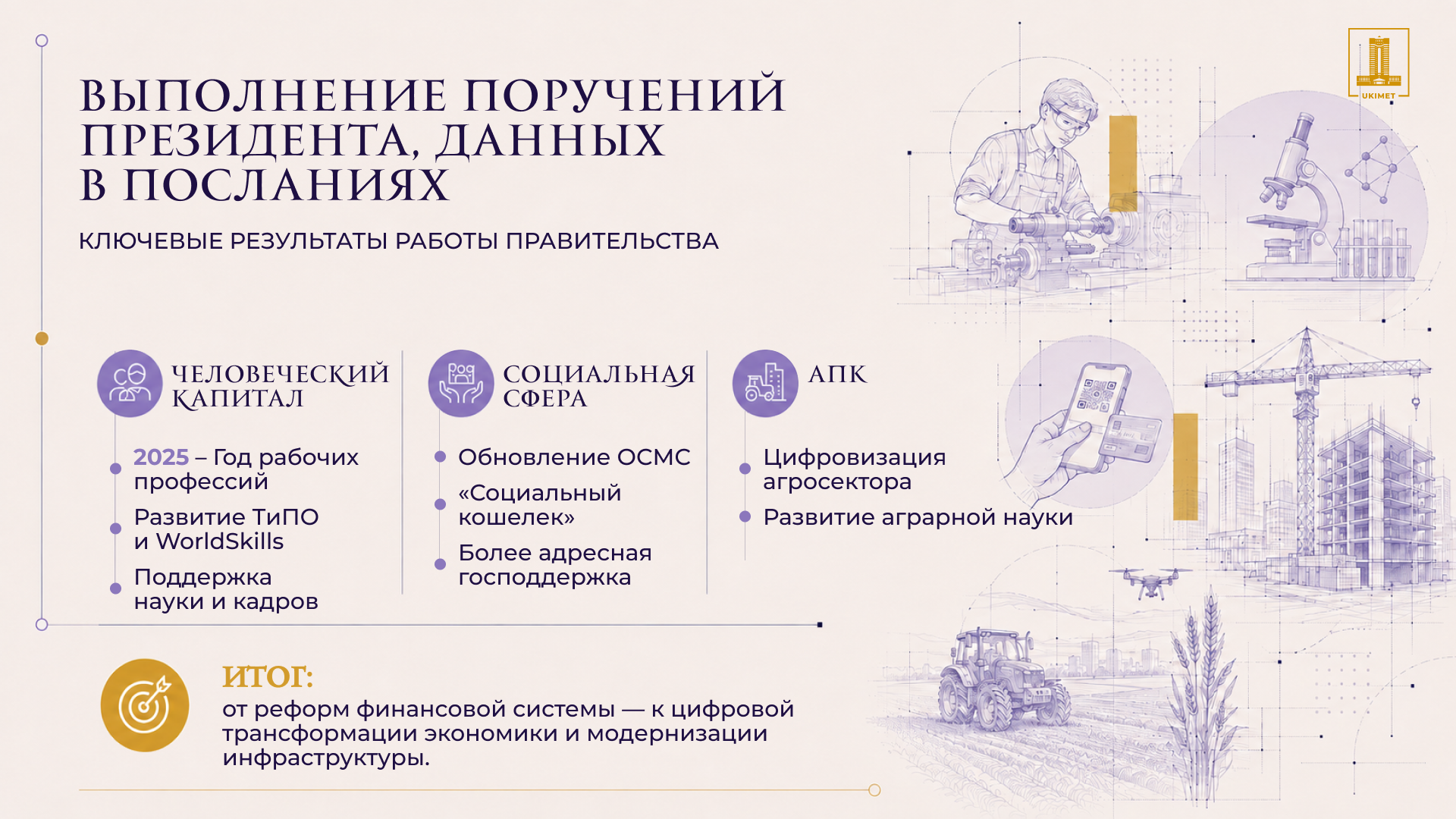
A separate area of work was the implementation of the Head of State’s initiative to declare 2025 the Year of Skilled Trades. Under the approved plan, systematic work has been launched to involve employers in workforce training, enhance the prestige of skilled trades and strengthen social guarantees for professionals.
Mechanisms for supporting research personnel continue to be improved. Amendments have been made to the rules for selecting applicants and undertaking research internships, providing for improvements to competitive selection, the establishment of a list of priority research areas and the expansion of the list of leading foreign organizations available for internships.
Healthcare remains an equally important area of social modernization. On 14 July 2025, a law concerning compulsory social health insurance was signed. It laid the foundation for a transition by 2027 to a predominantly insurance-based financing model. At the same time, mechanisms are provided to support socially vulnerable groups from local budgets, preserve insured status for six months in the event of an interruption in contributions, broaden the contribution base and strengthen state supervision.
Another practical social-policy instrument is the ‘Social Wallet’, launched in the eGov Mobile application. Its purpose is to improve the targeting and transparency of state assistance, automate the provision of support measures and reduce bureaucratic barriers.
Security: From Response to Prevention
A separate set of the Head of State’s instructions concerns strengthening law and order and public safety. The Law ‘On the Prevention of Offences’, signed on 30 December 2025, laid the foundation for a new model of preventive work. The system has been reoriented toward early identification of risks and timely prevention of offences.
A set of general, individual and special preventive measures is provided for. At the same time, the rights and duties of public assistants have been expanded, the powers of government bodies have been delineated, and mechanisms for inter-agency coordination have been established. This approach reflects one of the key principles of state policy: not only responding to problems that have already arisen, but also establishing mechanisms to prevent them.
Transition to a Digital Transformation Economy
While implementation of the 2024 Address was largely focused on strengthening economic and social resilience, the 2025 Address sets the next horizon: the digital transformation of the state and economy and the development of Kazakhstan in the age of artificial intelligence.
Within the framework of the 2025 Nationwide Action Plan, an updated regulatory, legal and institutional framework has been established, covering digitalization, investment, the real sector, the social sphere and public administration.
Digital Code and New Rules for the Economy
Kazakhstan has established unified rules for the platform economy, big data and AI. The legal basis for this model was established by the Digital Code adopted in January. The document creates a unified legal foundation for the digital environment, regulating the digital transformation of public administration and the economy, the platform economy, the use of big data and the application of artificial intelligence technologies. At the same time, it enshrines citizens’ digital rights and principles for the safe development of AI. In practical terms, this marks a transition from fragmented digitalization of individual processes to the establishment of a unified regulatory environment for the digital economy.
Investment: From Attracting Capital to Project Quality
The new stage of investment policy entails not only increasing the volume of investment, but also changing its structure in favour of high-value-added production. This objective is enshrined in the Investment Policy Concept of the Republic of Kazakhstan through 2030.
To strengthen the external investment framework, the overseas network of JSC NC Kazakh Invest is being expanded, an Investment Board is being established under Baiterek Holding, and the Kazakhstan Investment House single centre has been launched on a ‘one-stop shop’ basis.
Accordingly, investment policy is gradually shifting from merely attracting capital to establishing a comprehensive investor support system, from the initial inquiry through to project implementation.
The State in the Economy: Greater Efficiency and Transparency
Another important reform priority is improving the efficiency of state asset management. The next stage of the reform is expected to be a new Law ‘On State Property’. The draft provides for a clear definition of the grounds for state participation in the economy, the establishment of KPIs for state-owned companies and the classification of organizations according to ownership objectives.
The subsoil-use sector is being reformed in parallel. The Law dated 30 December 2025 amended the Code ‘On Subsoil and Subsoil Use’ with the aim of increasing transparency and digitally transforming geological exploration and resource development processes.
From Agricultural Science to Higher Productivity in the Agro-Industrial Complex
Digital transformation also extends to the agro-industrial complex. A Roadmap for the Development of Agricultural Science through 2029 has been approved, aimed at modernizing the agricultural science system, improving its efficiency, introducing digital technologies, and strengthening cooperation among science, education and industry.
Implementation of these measures is creating an innovation-oriented agricultural science system that ensures the sustainable development of the agro-industrial complex through digital technologies, higher productivity and the practical application of scientific developments. To this end, the state will ensure uninterrupted funding for scientific research, modernization of the material and technical base of research organizations, and the creation of the conditions necessary to conduct research and implement its results.
To improve the effectiveness of scientific developments, the formulation of terms of reference places primary emphasis on the actual needs of businesses. Research activities are thereby being reoriented toward solving practical problems and ensuring demand for research outcomes. As a result, the share of scientific developments implemented in the agro-industrial complex will be increased to 40%.
Modern Construction and Urban Development
The infrastructure framework for urban development acquired a new regulatory basis with the adoption of the Construction Code, signed by the Head of State on 9 January 2026. The document forms part of the systematic modernization of urban-planning regulation and is intended to ensure more modern approaches to the development of urban infrastructure and the construction industry.
The objectives of this Code are to ensure the safety of people and facilities, simplify and digitalize procedures, promote quality and accountability, establish uniform rules, develop infrastructure and create a comfortable environment.
Implementation of the nationwide plans is ongoing. Overall, the Government has already implemented a comprehensive set of measures in the key areas identified in the Addresses of the Head of State, while the practical implementation of decisions aimed at sustainable economic growth, technological modernization, infrastructure development and improved quality of life for citizens remains the central focus.